The Token Is Not the Thought
Part 1 of 4: The quiet assumption hiding at the center of modern AI.
01The quiet assumption
If you spend enough time building language models, you eventually run into a strange tension at the heart of our field. Over the last few years, we have built machines that can write software, untangle mathematical proofs, and carry on conversations that would have seemed like science fiction a decade ago. Yet nearly all of this intelligence has been squeezed through a remarkably narrow keyhole: predicting the next word in a line of text.
The results of scaling that simple objective have been so dazzling that the field quietly accepted a much larger assumption about the nature of intelligence itself. We began treating the linear sequence in which a thought is expressed as the natural medium in which that thought should be computed.
At first blush, the assumption feels harmless. Language arrives in a line, stretched out across time. When someone speaks to us, we hear the first word, then the second, then the third; when we read, our eyes march across a row of symbols; when we write, we lay down one word after another. Because language travels in a sequence, it is tempting to assume that comprehension is just sequence processing at scale.
But pause for a moment and watch what your own mind does when it actually understands something.
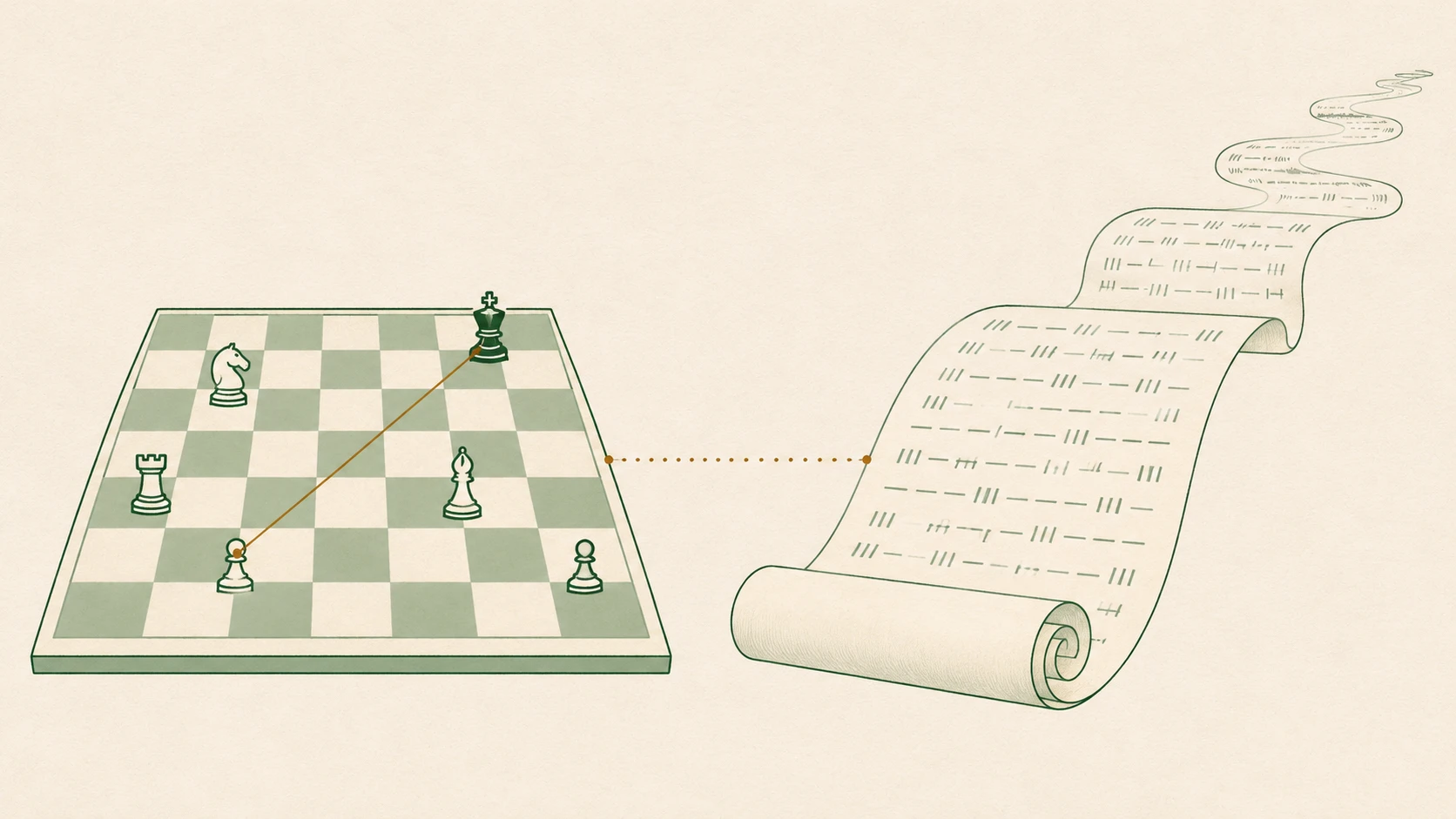
Suppose a friend sits down across from you over coffee and tells you about a chess game they played the night before. They describe a quiet opening, a sharp exchange in the center, a knight pinned helplessly to the king, and the final quiet move that forced their opponent to resign. As you listen, you are not maintaining a verbatim court transcript of your friend’s sentences inside your head. You are building a board. Pieces appear, tension forms along diagonals, threats open and close. By the time your friend reaches the end of the story, you hold the geometry of that final position in your mind, even if you could no longer repeat a single sentence they used to describe it.
Now imagine a grandmaster forced to play under a bizarre handicap: they are forbidden from holding a picture of the chessboard in their mind. Instead, before every move, they must stare at a lengthening scroll of algebraic notation:
1. e4 e5 2. Nf3 Nc6 3. Bb5 a6...In purely mathematical terms, nothing is missing from that scroll. Every piece’s location is implicitly recoverable from the history of moves. Given enough time, the grandmaster can scan backward from move one, replay the trajectory of every pawn and bishop, and figure out where the pieces stand today. You could even help them out with clever engineering: giving them a faster index to search the scroll, or compressing the font so more moves fit on a page.
Yet none of that fixes the underlying absurdity of the setup. Why spend immense energy re-deriving the state of the world from a history of symbols at every step, when you could simply maintain the board?
That question was the starting point for Sphota, an architecture that recently allowed our 240-million-parameter model, trained on just 2 trillion tokens, to outperform heavily optimized models nearly three times its size and trained on five times as much data. To understand why changing the workspace of a model shifts its efficiency so sharply, we have to look closely at an architectural decision that shaped modern AI.
02The Triumph and the Tax of a Sequence Machine
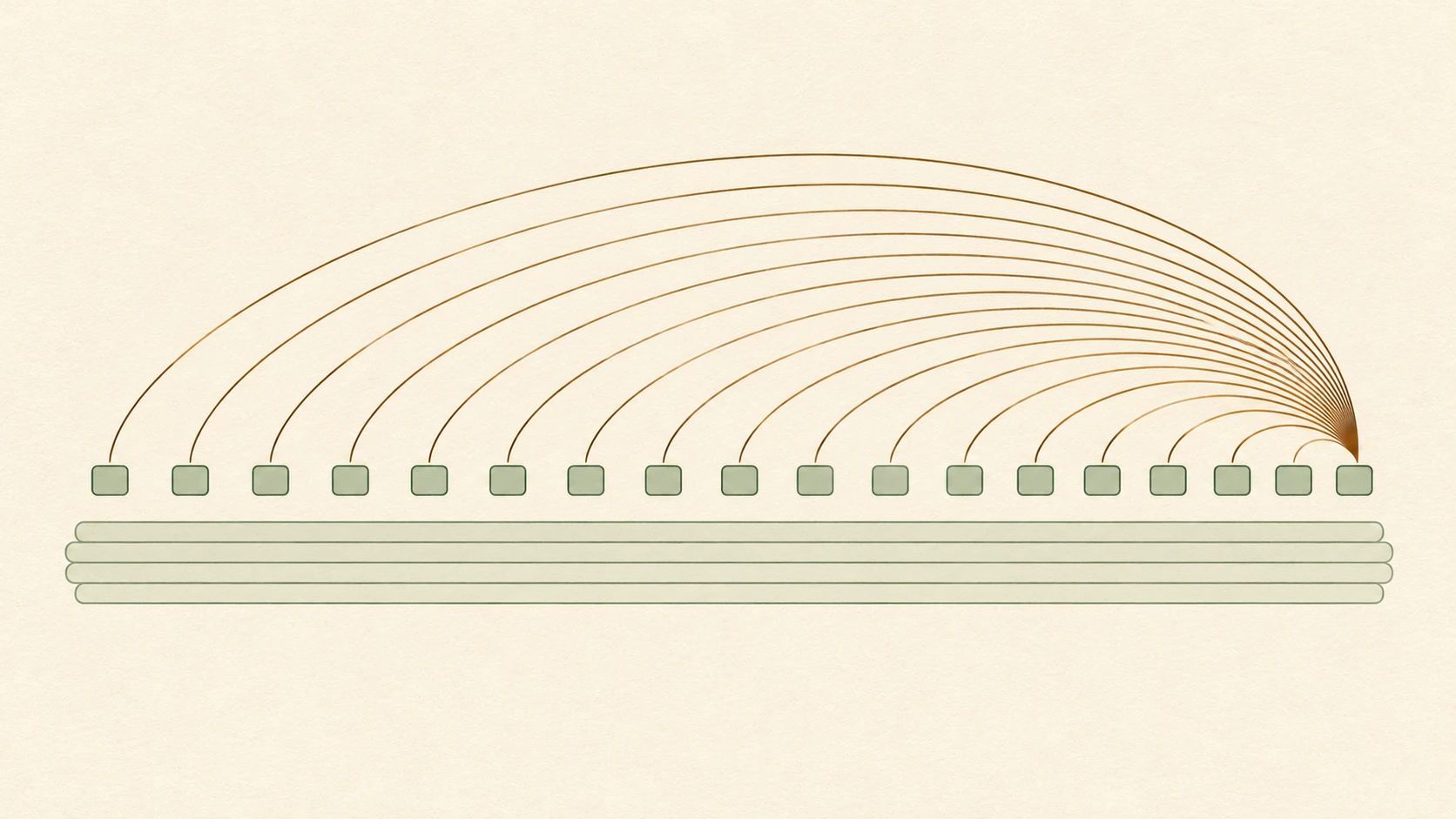
When the Transformer was introduced in 2017, its great breakthrough was freeing sequence models from having to march strictly one step at a time. Through self-attention, every token in a passage could reach back and exchange information directly with every earlier token.
What followed was one of the great empirical surprises in the history of computer science. Instead of hand-coding formal rules for grammar, world knowledge, or logic, we discovered that if you train a massive neural network to predict the next token across trillions of words, an extraordinary amount of structure emerges on its own. We never gave these networks an explicit mathematical definition of causality, intent, or irony; they forged working internal representations of those concepts simply because doing so helped them guess what word comes next.
There is something genuinely beautiful about that discovery. Yet a powerful training objective is not automatically the best computational workspace for everything that emerges from it.
The next token prediction gives us a universal way to teach a network. It does not follow that the raw sequence of tokens must remain the primary scaffolding inside which the network holds and updates what it knows.
In a conventional autoregressive Transformer, memory is organized around token positions. As the model reads or speaks, a Key-Value (KV) cache stores the intermediate activations of past tokens so the network doesn't have to recompute them from scratch. That cache is a brilliant piece of engineering, and recent flagship models like DeepSeek have gone to extraordinary lengths to compress and route it efficiently. Still, the cached information remains bound to the linear sequence of words that produced it. Meaning is nowhere in particular, so it has to be recovered from everywhere at once, by sending attention heads reaching backward across the transcript whenever the next word needs context.
Consider a simple three sentence story:
Ravi left his notebook on the kitchen table. An hour later, while he was out, Meera moved it to the bookshelf. When Ravi walked back into the kitchen, he looked for his notebook.
Any human reader immediately grasps two distinct facts: the notebook is physically on the bookshelf, and Ravi still believes it is on the kitchen table. Two diverging states, physical reality and a character’s private belief, now coexist inside the same small world.
Now imagine stretching that story across three hundred pages, weaving in dozens of people, shifting alliances, broken promises, and corrected assumptions. As humans read a novel, the exact wording of Chapter 1 fades almost completely from memory within minutes. What survives is an evolving mental state of who knows what, who owes whom, and how the pieces on the board currently stand.
A standard Transformer can learn to track these relationships, and at large scale it does so impressively well. But because the architecture offers no dedicated, persistent workspace where the current state of the situation is required to live, that understanding remains scattered across thousands of token-conditioned activations. Every time the story takes a turn, the network pays a quiet computational tax: reaching back through the history of words to re-assemble a world it already understood a moment ago.
03Remembering the Words vs. Remembering What Happened
The difference between a transcript of words and a state of meaning becomes even sharper when we look at how language handles ambiguity and paraphrase.
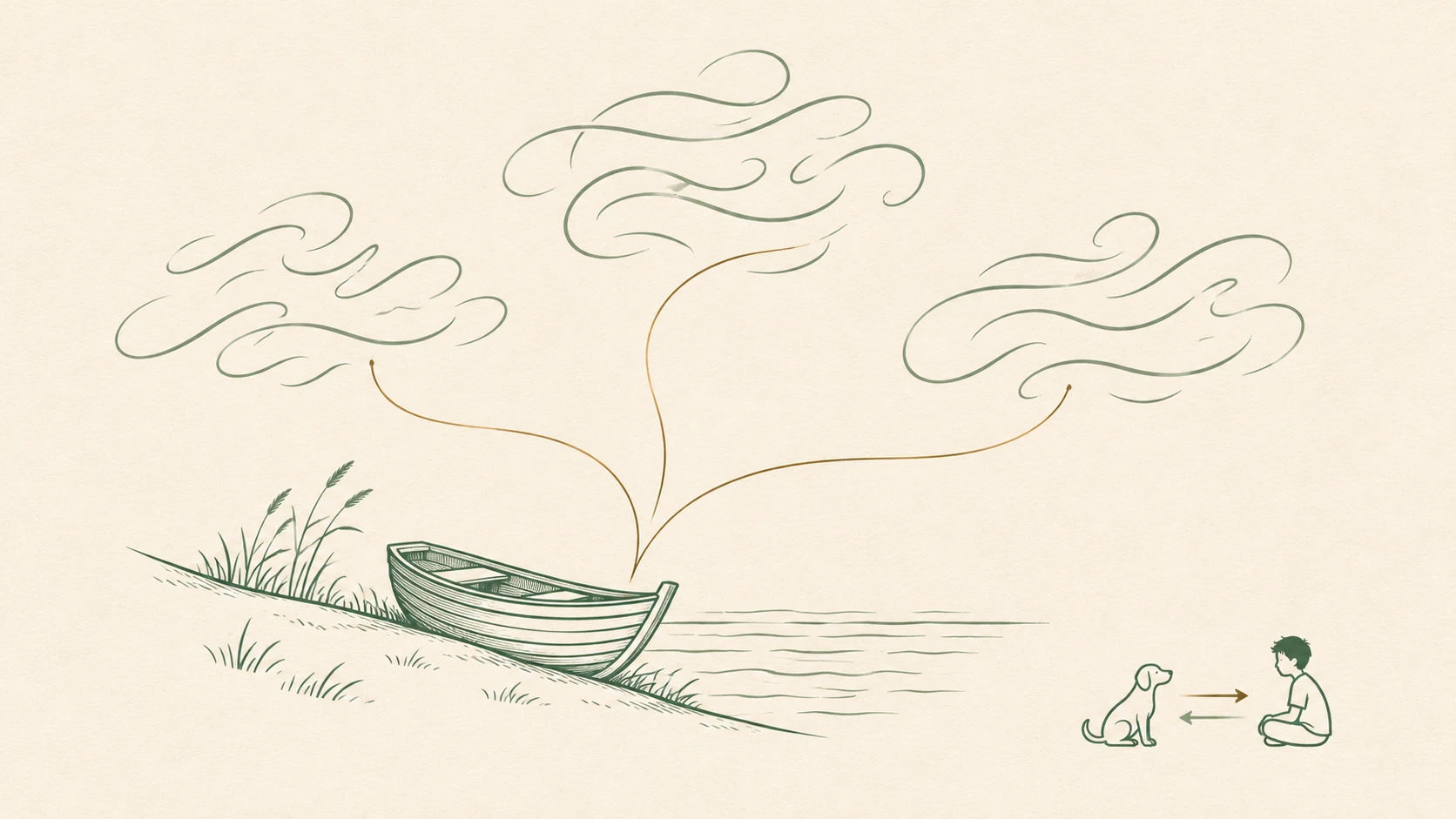
When someone says, "The bank was steep, so we pulled the boat ashore," the word bank initially hangs in the air unresolved: it could be a financial institution or the edge of a river. By the time the speaker reaches the word boat, the ambiguity vanishes.
Notice what changed at that moment. The acoustic sound of the word bank did not change; the past is fixed. What changed was the listener's internal model of the scene. The incoming words acted as progressive constraints until a coherent picture locked into place: a river, a steep slope, a boat being hauled onto land. And once that picture settles in your mind, you could turn around and describe the exact same event in Hindi, Tamil, or French, swapping out every single word and grammatical rule on the surface while leaving the underlying reality untouched.
Conversely, a tiny shift on the surface can invert the entire reality underneath:
The dog chased the boy.
The boy chased the dog.
Here the vocabulary is identical; not a single token has been added or removed. Yet the causal arrow between the two actors has flipped 180 degrees.
An intelligent system must be built around this fundamental asymmetry of language: it must remain rock-steady when the same reality is dressed in different words, yet reorganize itself instantly when a small detail changes what the story actually means.
What would happen if, instead of forcing a network to carry its worldview across a growing trail of token representations, we gave it a dedicated mathematical space where its current interpretation of reality could live and evolve? A place where entities persist, relationships flip when new evidence arrives, and outdated assumptions are overwritten directly: something closer to the chessboard than the move list.
04What We Set Out to Build
When we began designing Sphota, we had no interest in throwing away the lessons of the Transformer or denying the power of next-token prediction. We wanted to introduce a cleaner separation of duties inside the architecture itself: a boundary between the language a model encounters and the state of meaning it maintains.
In this regime, an incoming token is treated as a piece of evidence. It might introduce a new entity, tighten a constraint, or overturn something the model believed five sentences ago. The network’s job is not merely to tack that token onto the end of a historical buffer; its job is to compute how that evidence alters the current state of the world.
At the core of Sphota sits a persistent, non-verbal computational workspace we call the Sphota Field or the S-Field. As tokens arrive, bounded updates extract the structural shift they carry and fold it directly into this field. When the model needs to speak, it projects its response from this evolving state rather than relying solely on all-to-all lookups across the raw sequence of past words.
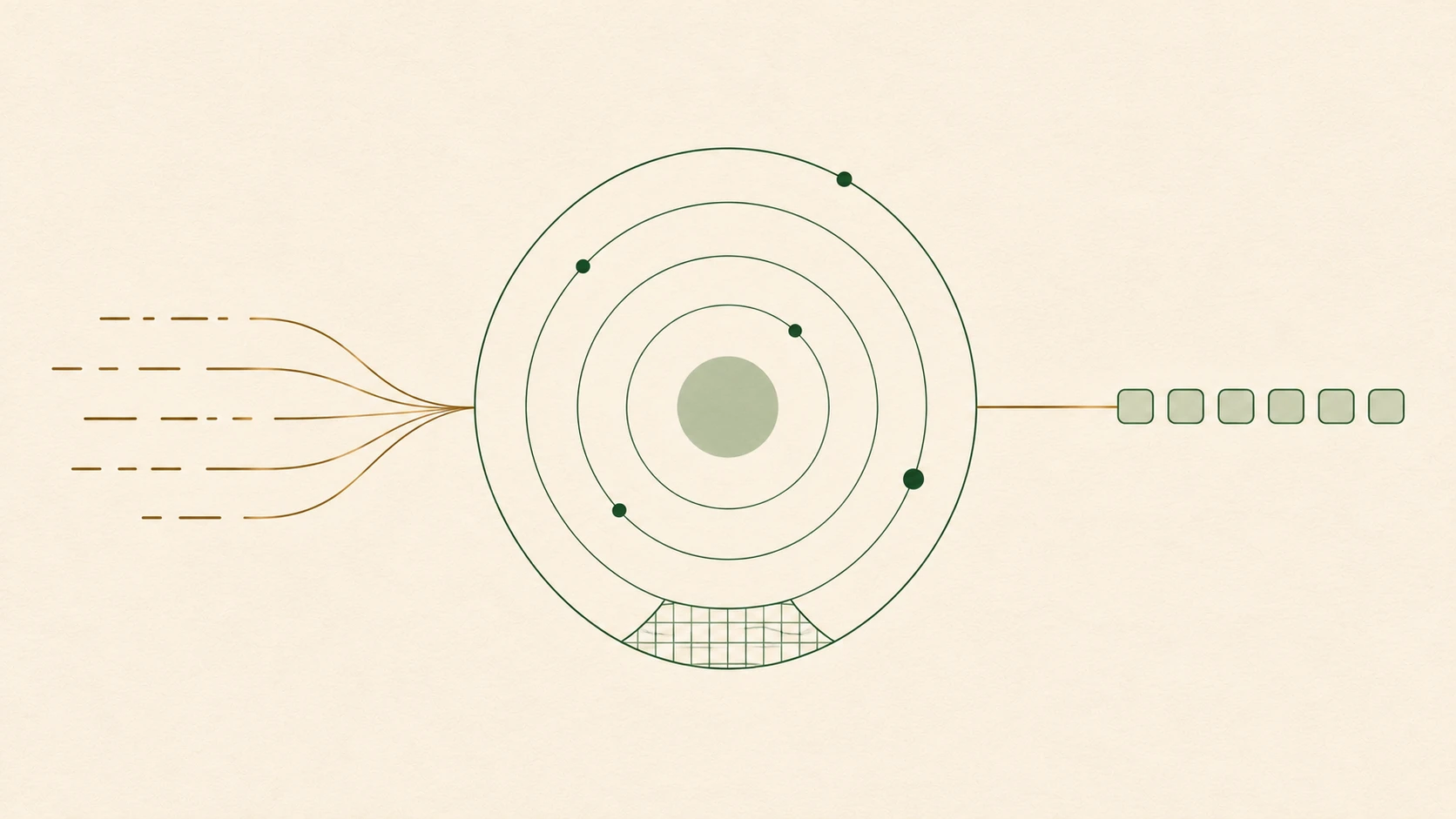
Of course, abstracting meaning away from text immediately runs into a practical trap. We call it the Precision Paradox. If you compress a conversation into a purely abstract gist, the model becomes useless the moment a task demands an exact serial number, a line of Python syntax, a dollar figure, or a verbatim clause from a contract. Understanding the spirit of an agreement does not excuse forgetting the date it was signed.
To solve this, the Sphota architecture establishes a clear division of labor. The S-Field governs global interpretation, intent, and causal reasoning, freeing the network from re-parsing the world from scratch at every step. At the same time, through context-aware information integration, the model stays grounded in this evolving state while still honoring exact words, numbers, and code syntax whenever precision matters.
Striking the right mathematical balance between structural persistence, verbatim recall, and compute cost is not a trivial problem. Compress too aggressively, and subtle nuances vanish; preserve every surface fluctuation, and you are right back to paying the full tax of the transcript.
Framing the problem this way changes how we design a foundation model. Conventional token-centric architectures focus on making access to historical information more efficient. Sphota takes a different approach: the network learns to preserve what matters from its history inside the S-Field, rather than repeatedly reconstructing it from the sequence of tokens.
05Before the First Word
There is one last observation that led us down this road, and it is much older than computer science.
Think about the fraction of a second just before you open your mouth to explain a complex idea. At that moment, you rarely have the exact sentence pre-written in your head. You might start a phrase, catch yourself, cross it out mid-breath, and try a cleaner angle. You will naturally choose completely different words depending on whether you are explaining the idea to a fellow engineer, a ten-year-old child, or a close friend.
Yet beneath all of those shifting attempts at expression, the thing you mean, the unified state of understanding you are trying to hand over to another mind, is already there, guiding the choice of words and telling you when a sentence has missed the mark.
That simple human experience points toward a profound architectural possibility: the structure a mind uses to hold a thought does not have to be the structure it uses to speak.
Nearly fifteen hundred years ago, long before silicon or probability theory existed, the Indian grammarian-philosopher Bhartṛhari wrestled with this exact puzzle. How, he asked, does a listener grasp a single, unified flash of meaning from a sequence of spoken sounds that arrive one by one and vanish into thin air the instant they are uttered?
His answer centered on a concept he called sphoṭa, and it sparked a centuries-long debate with rival schools of Indian logic that reads uncannily like a debate over the future of modern AI.
We will step into that 1,500-year-old argument in Part 2. For now, it is enough to notice the question sitting quietly in front of us. We have spent decades teaching machines to predict the next word. Perhaps the next leap begins by asking what exists before the first.